


Flappy Ball
Engineered for 60 FPS precision, zero touch latency, and authentic impulse physics. Tap to fly, dodge obstacles across 5 journey levels, and experience pure arcade rhythm offline.
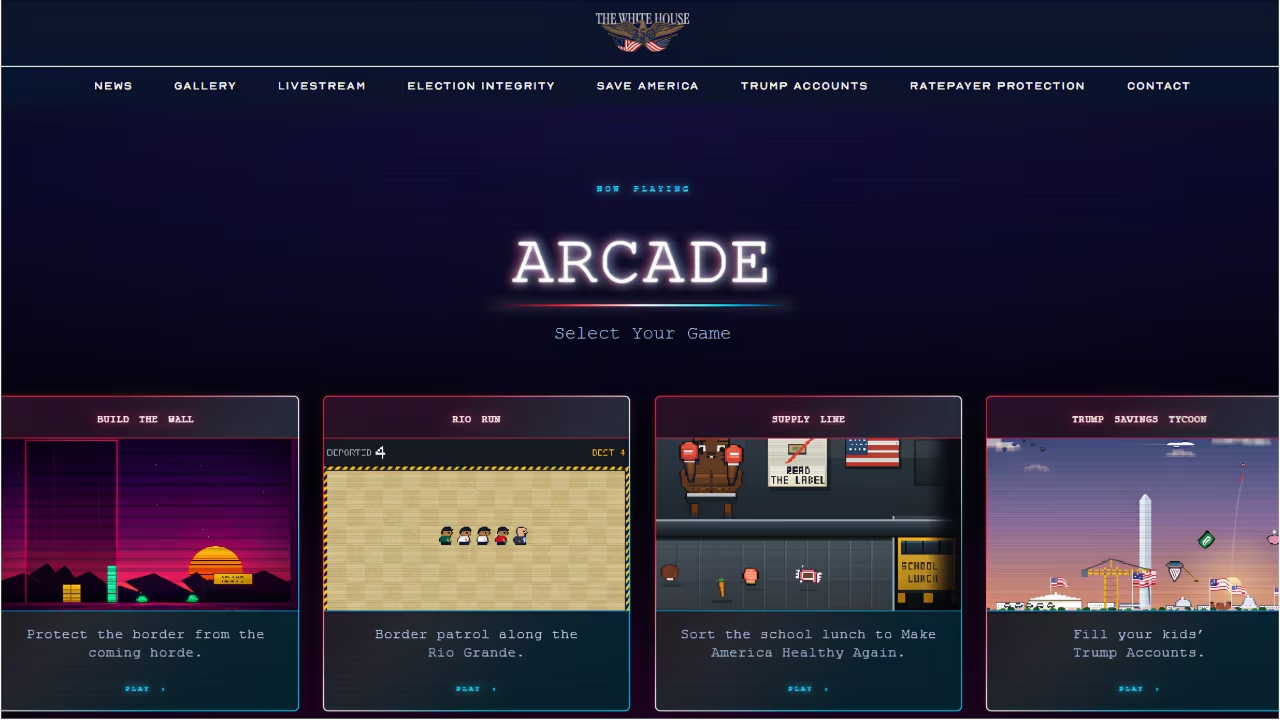
In an unexpected intersection of digital culture and federal communication, the official White House portal launched the White House Arcade (whitehouse.gov/arcade). Among its lineup of nostalgic, browser-based 8-bit titles, one particular title immediately captured the internet's attention: 'Flappy Bill'. Built around the iconic one-tap mechanics popularized by the 2013 smash hit Flappy Bird, the game challenges players to steer a cartoon legislative bill through a gauntlet of political and bureaucratic barriers.
The White House Arcade Phenomenon
Government digital outreach has traditionally relied on press releases, PDF reports, and formal video briefings. The launch of the White House Arcade marks a notable shift toward gamified public engagement. By packaging civic concepts—such as navigating a bill through committee debates, filibusters, and executive hurdles—into instant retro games, the initiative demonstrates that arcade gameplay remains one of humanity's most universally understood digital languages.
One-button tap games succeed because they reduce the input barrier to zero: no directional thumbsticks, no combo sequences, no steep learning curve. A player understands the entire ruleset within three seconds of picking up the game.
Dissecting 'Flappy Bill': Political Satire Meets Retro Gaming
In 'Flappy Bill', players guide an animated document through tightly spaced columns representing Capitol Hill obstacles. With every tap, Bill flaps upward against simulated gravity; release the controls, and gravity accelerates him toward the floor. The game cleverly captures the precarious journey of federal legislation: a single miscalculated tap or hesitation leads to an immediate crash.
While Flappy Bill serves as an entertaining browser novelty, it highlights the technical constraints of web-based gaming. Running inside modern web browsers with variable JavaScript frame scheduling, browser canvas games frequently suffer from micro-stutters and input lag that can frustrate players seeking high-score precision.
The Mathematics of Tap Physics: Gravity, Impulse & Collision
What makes tap-to-fly games addictive is the rigorous physics calculation executing under the hood. In video game physics engines, the entity's position is updated every frame using standard kinematic equations:
- Downward Gravitational Acceleration: A continuous negative velocity increment applied to the vertical vector (v_y = v_y - g * dt).
- Instantaneous Tap Impulse: Upon detecting a touch event, vertical velocity is abruptly reset to a positive upward impulse (v_y = +impulse_force), overriding downward momentum.
- Parabolic Flight Arc: The natural arc allows the player to estimate whether the entity will clear the next threshold before falling into the hazard zone.
- Precision Hitbox Geometry: Using circular bounding volumes for the player entity and axis-aligned bounding boxes (AABB) for obstacles prevents unfair visual clipping collisions.
Web Canvas Latency vs. Native 60 FPS Mobile Physics
When playing high-speed reflex games on the web, input latency is the primary bottleneck. Between the browser's touch event listener, JavaScript garbage collection cycles, and DOM composite painting, total input-to-render delay can exceed 60 to 80 milliseconds. In a game where obstacle gaps are barely 1.5 times the player's height, 50ms of lag guarantees a collision.
This is where native mobile engineering makes all the difference. On Android, a dedicated physics loop written in native code or compiled via hardware-accelerated OpenGL/Vulkan pipelines polls touch digitizers at 120Hz or 240Hz. Visual frames are rendered at an unwavering 60 FPS or 120 FPS, reducing input latency to under 16ms.
How DIOUANE's Flappy Ball Perfects the Tap-to-Fly Formula
If you enjoyed the addictive reflex challenge of Flappy Bill and want a refined, lag-free mobile arcade experience, DIOUANE's official Android title Flappy Ball was built specifically for you. We engineered Flappy Ball from the ground up to eliminate the frustrations common in modern casual games.
• Ultra-responsive 60 FPS native physics engine with zero touchscreen delay. • 5 progressive journey tiers: Rookie, Pro, Elite, Champion, and Master endless mode. • Rich atmospheric visuals, dynamic night lighting, and tactile haptic vibration feedback. • 100% offline-first architecture: zero mandatory logins, zero internet requirement, and minimal battery consumption.
Unlike browser games that require constant Wi-Fi connectivity and drain your battery with background web workers, Flappy Ball operates entirely on your device. Whether on a commute, in flight mode, or relaxing at home, your reflexes are met with instantaneous touch response.
Pro Strategies: How to Conquer Endless Obstacle Traps
Whether navigating Flappy Bill on whitehouse.gov/arcade or climbing the master leaderboards in Flappy Ball on Android, these proven tactics will help you consistently break past your score plateaus:
- Tap Early on Ascent: Never wait until your entity is descending rapidly before tapping. Recovering from downward terminal velocity requires multiple rapid taps that compromise control.
- Aim for the Lower Gap Threshold: Gravity accelerates falls much faster than players anticipate. Keeping your trajectory closer to the lower third of each opening provides more reaction room.
- Develop a Metronomic Tap Rhythm: Treat tap games like a musical instrument. Maintaining a predictable, steady pulse stabilizes your vertical hover oscillation.
- Eliminate Screen Glare & Input Friction: Use a clean screen and hold your device with both hands to stabilize your tapping thumb for sub-millisecond precision.
Experience Flappy Ball Today
Tested for Android 10 through Android 15+. Fast, lightweight, and engineered with complete respect for your privacy and battery life.
Install Flappy Ball on Google Play ↗